Like every kid with chicken pox, I decided this morning after my shower that I better count just how many bumps/blisters cover my adult body. I`m at 72 today. The worst is my face. I`ve got about 11 or so on my now-ugly mug. Enough to keep the perverted construction workers from whistling at me each time I walk by to get coffee or a water, though. Not necessarily a bad trade :) But the medicos promise me that if I don´t pick, the marks won`t be permanent. Let`s just say me and my vanity are crossing our fingers.
Of course I feel like kind of a freakshow for being one of the very, very few adults who get chicken pox for the second time. Seriously, as most of my friends would concur, I`m exactly the person this would happen to. Especially while travelling abroad.
But according to various Googled Web sites, ¨people cannot get chicken pox twice.¨ Again, only me.
Needless to say, it`s not the worst ailment I`ve ever been afflicted with. I remember it being much worse as a child. According to my adolescent memory, I was the first kid in Mrs. Schwartzman´s first-grade class to get the chicken pox. I think it`s the only sickness where you actually get to play with your friends. The moms of my classmates wanted us all to get the virus at the same time and get it over with, so we got to play together after school that day. But what followed could only be described as itchy hell. I vaguely remember my mom soaking me in a vat of calamine lotion followed by ice packs. I`ve definitely taken the route of calamine lotion this time around, too.
As it happens, that cold/cough that I couldn´t kick after leaving Buenos Aires was likely a precursor to my second bout with varicella. Turns out not only do a get a note to stay home from school - just like when I was kid - but now I`m taking herpes medicine. Or so I understand it in Spanish. Alex and I are planning to take this week off from language school and start right back up on Monday.
Assuming I look normal again, of course.
- JMH
Wednesday, November 14, 2007

Tuesday, November 13, 2007
Adventures in Health
 Joanna smiles if only for a moment in the new hotel room, pineapple pizza in hand and face covered with calamine lotion at the safety of a less than deadly diagnosis. - AC
The word for mosquito bite in Spanish is picadura.
After hearing horror stories of malaria and bird sized South American bugs, we did our research before leaving the United States. Argentina, we were relieved to learn, does not pose a threat of malaria or even of exsessive insects, especially not in the middle or south of the country. The northern borders with Bolivia and Brazil can be dicey, but still not as dangerous as other places.
Both in Buenos Aires and now in Córdova, we haven´t seen an inordinate amount of bugs. Both of us got some picaduras in BA, but nothing out of the ordinary.
It didn´t raise suspicion when relatively normal looking picaduras started showing up on Joanna´s legs and hands. At first only a few, very itchy. But then, after a day and a half they seemed to multiply like an alien invader from a bad science fiction film.
Upon awaking Monday morning to find nearly 50 bites we became concerned. After four hours of class she had noticed half a dozen more. We asked the staff at school to please call a docter, which they had explained was no big deal.
The two who came were not doctors but paramedics, emergency responders. In a whirlwind of rapid Spanish and quick evaluation, the long haired one who constantly spat out wisecracks produced a needle while explaining in broken English that she was having an allergic reaction.
Joanna´s eyes instantly welled up and her body language screamed uncertainty. "Un momento, por favor," we asked them. We asked what the injection was - an antihistemine. We asked if it was necessary - no, but it would help. We asked if we could speak with our school administrator who could translate, to put the mind at ease and make sure we knew what was happening.
That´s when our needle toting medic got offended. He took the needle apart, practically throwing things back into his bag.
"Our time is precious," he told us.
It seemed that if we didn´t want to take his "treatment" on faith and trust his training, and ignore the fact that he hadn´t asked about other medications or anything besides allergies and that none of us were speaking our true trusted native tongue, then he would just go and we could suffer our fate alone.
Some four or five hours later, after having a pharmacist tell us we should consult a doctor and arriving at the public hospital to find the office of an alergist closed, taking a cab home defeated, recieving frightening advice from a family doctor at home and then concurrant advice from a doctoral student in our hostel, we found ourselves in the emergency room of the private hospital three blocks from our residence.
Lip quivering and eyes puffed and red from sporadic crying and fear, Joanna´s mind raced to her terrifying unexplained 10 day stay in a Venice hospital years earlier.
"I can´t do this again. I don´t get it, there´s more." It seemed every few minutes a new picadura would appear, unexplained and more itchy than the last.
The very nice doctor who saw us in the ER told her in broken English not to be scared, it wasn´t dangerous and looked like an allergic reaction, after consulting with her boss she settled on a shot, benedryl, a similar but intrevienous dose of what she had taken - to no avail - earlier. The doctor wrote a note in Spanish for the hospital´s Dermotologist to squeeze Jo into the schedule in the morning, and in the meantime the shot should help the itching and if there was a fever or swelling of the lips and/or tongue we should come back immediately.
Panic replaced sleep through the rest of the night in our small room at the noisy party happy hostel.
By 9:30 the next morning we were again staring at the tile floors in a steril, incandesently lit hospital waiting room among a crowd of quiet nervous looking people.
Finally Alejandro, the Dermatologist, called her name. Like all the others, he pronounced the A more firmly than the H in Hartman.
His calm demeanor and unhurried pace was a welcome change. He took his time, he looked into a book. His colleague came into the room for a medical device and Alejandro asked for a cosultation. They both examined, discussed and settled.
Smallpox.
Joanna´s eyes got wide. My brain raced, wasn´t that what killed the Native Americans?
Alejandro saw our concern. He consulted his book, he explained in Spanish, eventually we understood.
Joanna, somehow, has succeded in once again coming down with a rare illness. Something that might not be abnormal when rolling off the tongue, but for a traveler, for an adult, she is strange.
When we climb onto planes headed for exotic locations we pack antibiotics, immodium, we get innoculated for yellow fever, we bring malaria pills and pepto bismol. It is these things that are written up in the health section of the travel guide; watch for these syptoms, if this persists seek medical help. But we never prepare for the illogical, for the strange and extremely abnormal.
Somehow, my traveling partner has managed to become a statistic, one of a miniscule percentage of the population who twice in their life suffers through an illness we all get once.
But now she´s fine, she´s not scared anymore. Alejandro gave her some pills for the symptoms and we splurged for a comfortable hotel room with a private bathroom and all the American TV she can handle. A recovery center of sorts.
And beside picadura, we learned a new word.
In Spanish varicela means chicken pox.
- AC
After hearing horror stories of malaria and bird sized South American bugs, we did our research before leaving the United States. Argentina, we were relieved to learn, does not pose a threat of malaria or even of exsessive insects, especially not in the middle or south of the country. The northern borders with Bolivia and Brazil can be dicey, but still not as dangerous as other places.
Both in Buenos Aires and now in Córdova, we haven´t seen an inordinate amount of bugs. Both of us got some picaduras in BA, but nothing out of the ordinary.
It didn´t raise suspicion when relatively normal looking picaduras started showing up on Joanna´s legs and hands. At first only a few, very itchy. But then, after a day and a half they seemed to multiply like an alien invader from a bad science fiction film.
Upon awaking Monday morning to find nearly 50 bites we became concerned. After four hours of class she had noticed half a dozen more. We asked the staff at school to please call a docter, which they had explained was no big deal.
The two who came were not doctors but paramedics, emergency responders. In a whirlwind of rapid Spanish and quick evaluation, the long haired one who constantly spat out wisecracks produced a needle while explaining in broken English that she was having an allergic reaction.
Joanna´s eyes instantly welled up and her body language
 screamed uncertainty. "Un momento, por favor," we asked them. We asked what the injection was - an antihistemine. We asked if it was necessary - no, but it would help. We asked if we could speak with our school administrator who could translate, to put the mind at ease and make sure we knew what was happening.
That´s when our needle toting medic got offended. He took the needle apart, practically throwing things back into his bag.
"Our time is precious," he told us.
It seemed that if we didn´t want to take his "treatment" on faith and trust his training, and ignore the fact that he hadn´t asked about other medications or anything besides allergies and that none of us were speaking our true trusted native tongue, then he would just go and we could suffer our fate alone.
Some four or five hours later, after having a pharmacist tell us we should consult a doctor and arriving at the public hospital to find the office of an alergist closed, taking a cab home defeated, recieving frightening advice from a family doctor at home and then concurrant advice from a doctoral student in our hostel, we found ourselves in the emergency room of the private hospital three blocks from our residence.
Lip quivering and eyes puffed and red from sporadic crying and fear, Joanna´s mind raced to her terrifying unexplained 10 day stay in a Venice hospital years earlier.
"I can´t do this again. I don´t get it, there´s more." It seemed every few minutes a new picadura would appear, unexplained and more itchy than the last.
The very nice doctor who saw us in the ER told her in broken English not to be scared, it wasn´t dangerous and looked like an allergic reaction, after consulting with her boss she settled on a shot, benedryl, a similar but intrevienous dose of what she had taken - to no avail - earlier. The doctor wrote a note in Spanish for the hospital´s Dermotologist to squeeze Jo into the schedule in the morning, and in the meantime the shot should help the itching and if there was a fever or swelling of the lips and/or tongue we should come back immediately.
Panic replaced sleep through the rest of the night in our small room at the noisy party happy hostel.
By 9:30 the next morning we were again staring at the tile floors in a steril, incandesently lit hospital waiting room among a crowd of quiet nervous looking people.
Finally Alejandro, the Dermatologist, called her name. Like all the others, he pronounced the A more firmly than the H in Hartman.
His calm demeanor and unhurried pace was a welcome change. He took his time, he looked into a book. His colleague came into the room for a medical device and Alejandro asked for a cosultation. They both examined, discussed and settled.
Smallpox.
Joanna´s eyes got wide. My brain raced, wasn´t that what killed the Native Americans?
Alejandro saw our concern. He consulted his book, he explained in Spanish, eventually we understood.
Joanna, somehow, has succeded in once again coming down with a rare illness. Something that might not be abnormal when rolling off the tongue, but for a traveler, for an adult, she is strange.
When we climb onto planes headed for exotic locations we pack antibiotics, immodium, we get innoculated for yellow fever, we bring malaria pills and pepto bismol. It is these things that are written up in the health section of the travel guide; watch for these syptoms, if this persists seek medical help. But we never prepare for the illogical, for the strange and extremely abnormal.
Somehow, my traveling partner has managed to become a statistic, one of a miniscule percentage of the population who twice in their life suffers through an illness we all get once.
But now she´s fine, she´s not scared anymore. Alejandro gave her some pills for the symptoms and we splurged for a comfortable hotel room with a private bathroom and all the American TV she can handle. A recovery center of sorts.
And beside picadura, we learned a new word.
In Spanish varicela means chicken pox.
- AC
Monday, November 5, 2007
The dollar is strong
Buenos Aires is said to be the most expensive city in the country, but right now the dollar has about three times the buying power as the peso.
Here are just a few things you can get for a nice price: Remember, US$1 = 3 pesos
- Roundtrip ticket from Baltimore, MD to Buenos Aires, Argentina = US$800
- 1 liter of local beer = 5 pesos
- 1 week of Spanish class and housing = 650 pesos
- Internet access for one hour = 1 peso
- (Relatively cheap) tango show = 40 pesos per person
- Cafe con leche = 4 pesos
- Steak = 5 to 35 pesos
- Beef empanada = 2 pesos
- One-way subway fare = less than 1 peso
- International stamps = 4 pesos each
- McDonald´s Meal Deal = 12 pesos
- All-you-can-eat Argentine buffet = 16 to 40 pesos
- Harry Potter book in español = 39 pesos
- Cheap men´s haircut = 7 pesos
- 2 tickets to B.A.´s "Broadway" production of La Joula de Los Locos (The Birdcage) = 120 pesos
- New heels and a little black dress = 145 pesos
- One-way overnight bus ticket to Cordoba (a 10 hour trip) = 100 pesos
Unfortunately the economy here is bad for the locals, but certainly a benefit to the traveler, particularly those with the dollar, Euro or pound.
- JMH
Monday, October 29, 2007
Election Time, Argentine Style

Normal, every day life on La Plaza Congreso is much like it is in any other urban plaza in cities throughout the world.
Children play fútbol during the afternoons. Lovers kiss on park benches into the night. Street people sleep in the grass, vendors peddle ice cream, business people walk briskly in all directions and traffic never ceases to buzz, honk and tear around the one way streets that surround the congressional plaza.
On the evening of October 28th, however, the traffic in La Plaza de los Dos Congresos was absent. No thundering buses to flatulate black smoke out onto the sidewalks. No honking taxis or impatient motorcycles zipping between lanes. People gently meandered down the middle of the streets without the usual automotive chaos.
It is not uncommon to pass large steel baracades when walking by the congressional building on the west end of the rectangular park. In fact, most government buildings in Buenos Aires are surrounded on all sides by large, cold, grated steel baracades.
But on this particular Sunday evening, the entire plaza was cordoned off. One block out on every single street stemming out from the plaza in each direction was a police baracade, made up either of the familiar cool blue mobile steel walls or just an officer next to his squad car. On the streets close to the congresional building itself, even pedestrians were not allowed through the gates.
"May I pass through?" I asked an officer at the gate in broken spanish.
"Where to?"
"To the café," I pointed up ahead, inside the baracade.
"No," he told me, with an ever so slight chuckle.
In the four days prior to the Sunday election day, I had seen two rallies in the Congresional plaza. They were animated, well attended and very, very lively. Neighbors had told me that the plaza was very popular for "parties."
 The second rally of the week rolled into town two days before the election behind a large flatbed truck carrying an armada of drummers, flag wavers and what sounded like gun shots but proved only to be firecrackers. Later, in front of a chanting, flag waving, smoke bombing crowd the voice of Néstor Pitrola, one of 14 canidates in the Argentine presidential election, crackled out over the plaza via loudspeakers.
In the end, Pitrola and all other 12 canidates never had a chance. Cristina Kirchner, the wife of current Argentine President Néstor Kirchner, pretty much had things locked up from the getgo.
Described by many locals as the "best of the bad," the Kirchner regime pulled Argentina out of economic hell, and the former first lady wiped up in the wake of her husband´s popularity with a 43% victory.
But on election night, the cold blue steel baracades were nonetheless set in place at a three block radius around the congresional building. Aside from a few bullhorn toting soapboaxers or the occasional horn honking bicyclist, the plaza saw little action thanks to the police presence.
After being refused passage through the baracade by the police, I walked around the block trying to get to my favorite diner for some empanadas and pizza slices. Suddenly, as I watched people walk past the baracade it dawned on me why alcohol had been illegal since 10 p.m. the night before.
While local porteños say the police presence was "just a precaution," it b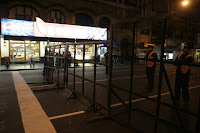 rings to light the passion of the Argentine people. They tear seats out and destroy stadiums at fútbol matches, they rally hard for political causes - when they show up for a rally they often carry sticks. Political revolution is not too far in the past of this country, and some of their most infamous figures are revolutionaries.
 rings to light the passion of the Argentine people. They tear seats out and destroy stadiums at fútbol matches, they rally hard for political causes - when they show up for a rally they often carry sticks. Political revolution is not too far in the past of this country, and some of their most infamous figures are revolutionaries.
If the Kirchner victory hadn´t been so well predicted who knows, maybe those cold, hard, steel baracades might have been tested.
- AC
PHOTOS: A dubious night sky backs the congressional building as a backdrop to a rally for Néstor Pitrola days before the election, top. Pitrola speaks to the press at the rally, middle. A police baracade one block from Plaza Congreso on election night, bottom. - AC
Saturday, October 27, 2007
So far I´ve seen ...

Shown here, ¨Sergio¨paints a downtown scene in the streets of Buenos Aires --- with his feet.
- JMH
Been here in Buenos Aires for over one week now and I´ve had my fair share of interesting sights and sounds - some fabulous, some obnoxious and some just plain interesting.
So far I´ve seen ...
· Dogwalkers. The porteños (BA locals) love their dogs and pay a dogwalker to exercise them while they´re at work during the day. We frequently see a person walking between 5 and 12 perros through the busy, traffic-laden streets.
· Very little access for the disabled. At the post office a woman in a wheelchair posted up at the front door and a postal worker ran to and from the counter to help her send off her packages.
· T&A on every corner. The cover of men´s magazines here bare naked booties and plenty of breasts.
· Unrefrigerated mayo. Plus they put this terrible concoction of mayo and ketchup on everything from salads to sandwiches. They call is ¨Salsa golf¨and it, too, doesn´t grace the fridge.
· A giraffe in the foreground and high-rise apartment buildings in the background. The BA zoo is actually very well stocked with hippos, lions and bears - all within the confines of a densely packed metropolis.
· Plenty of well-dressed business men --- with mullets.
· Fruit stands selling two oranges for the equivalent of an American quarter, and incredible steak for less than US$6.
· The World Press Photo exhibit.
· That it is indeed possible to finish eating dinner after 1 a.m. before heading out to the clubs until sunrise.
· Hugs for free in a city of 9 million.
· Political rallies outside my front door, gunshots and all.
· A child barefoot and juggling in the streets at 3 a.m.
· That it´s a small world after all. In my Spanish class of six, the only American is from Sacramento and spent his summers working in Tahoe.
· A man painting a streetscape with his feet in the middle of the most crowded pedestrian and shopping street.
And by the way, language school is great.
- JMH
Wednesday, October 24, 2007
La Ciudad; Parte Dos

After nearly a week in Buenos Aires, I have some observations.
My first sentiments, already published on this site, that most large capital port cities are the same, still stands. With each passing day, BA becomes more familiar, and whether it be that familiarity or not, the city seems like any other bustling machine of commerce.
The city itself is easy enough to navigate, being divided up into fairly distinctive barrios, or neighborhoods, which all utilize a basic grid system of streets. Thus far, we have explored two barrios fairly extensively.
Palermo, our first home in the city, is by far the biggest in BA. The porteños describe it as full of parks and green spaces. While the city´s biggest park and expanses of neighboring parks does exist as the edge of Palermo, anyone from the United States, and from the West Coast in particular would dissagree. The park is small and on the weekend turns into a superhighway of runners, walkers, rollerbladers and bikers making laps around its parimeter.
But Palermo´s streets are lined with trees, its sidewalks are broad and its attitude is slightly more laid back than in El Centro. As in all of BA, some of Palermo´s streets are old cobblestone surfaces, leaving cars, busses and taxis to bounce along noisily passed the cafés, chic boutiques and businesses that make Palermo the "uptown" of BA.
Palermo also houses the Buenos Aires Zoo, which is pretty much like any other city zoo and surrounded by tall residential buildings. The animals here seem slightly smaller than other zoos, but patrons can buy a bucket of comida de animales for one peso and feed the inhabitants who often perform (beg) for the small nibblits of food, so malnutrition is not to blame for their size.
Just a 10 minute ride from Palermo on the Subte, which is usually packed but not exceptionally unpleasent for an underground train, lies El Centro, the heart of BA and center for commerce, business and daily activity.
El Centro is much different from Palermo or the other quieter more hip barrios of town. The sidewalks are narrow, the streets more heavy with traffic and the people more dense. Most constantly come or go from the many sky scraping fortresses of commerce, government buildings or residences at all hours of the day. Small motorcycles dart in and out of the rapid but not completely chaotic traffic and busses barrel and choke noisily through the streets 24 hours a day.
Our daily walk from Plaza de los Dos Congresos to the school is made up of 15 minutes dodging people on sidewalks and trying to make three of the consecutive four lights on Avenida 9 de julio - a monstrous four road conglomoration divided by swaths of lawn and sidewalk.
It is true, the porteños love dogs, and the canines seem to take on the same personality as the people, like any other large city dwellers their demeaner is indiferant but generally content.
While many travelers complain that BA is dirty, I find it to exceed my expectations of a South American port. It is by no means clean, but trash cans line the streets and sewage seems to stay out of sight. Although dog crap is abundant - no need for little plastic baggies here.
Overall, especially for its size the city is pleasant and the people friendly. But for a nature loving boy from the mountains, even after just less than a week, I can hear the peaks of the Andes beckoning me out of the concrete jungle that is BA.
- AC
PHOTO
The statue and Argentine flag at the end of Plaza de los Dos Congresos is sillhouted by a cloudy evening sky. - AC
Friday, October 19, 2007
Learning to learn
I´m going to admit what few people would - by nature, I´m a quitter.
At first, it was all laughs.
¨I don´t even know what subjunctive, preterite or imperfect verbs are in English,¨ I joked to Alex.
¨What´s the word for ´love´ again?¨ he asked in return.
¨Seriously, I don´t even know what this stupid test is asking. The directions are even in Spanish.¨ I was getting increasingly frustrated.
¨Whatever. I don´t even want to learn Spanish anyway,¨I said again, reiterating my irritation at feelings of stupidity.
Not true. I do indeed want to learn a foreign language. And I know it´s going to be difficult. I just didn´t imagine I´d get discouraged so easily. And really, I thought I knew more Spanish than I apparently do.
Dad told me after one of his pilgramages across Spain or France that knowing a second language is like having a second soul. That stuck with me and has served, in part, as inspiration to pursue travel abroad.
Needless to say, I haven´t done anything new or hard in a little while. Not like when I was in college and each semester I started something challenging and foreign. At least at first. And of course when I started at the newspaper I faced overwhelming feelings of inadequacy. So I should be perfectly suited to relate to those feelins all over again, right?. But I still don´t like them. No one does.
And no, I don´t actually plan on quitting. I just think about it. And maybe whine a little bit here and there. And so when Monday comes and I´m in a whole new classroom in a whole new part of the city with all new people, I know that if nothing else, I´m at least accountable to anyone who reads this blog. No matter what, I´ll return home knowing more about español, Argentina - and myself - than I did when I left.
JMH
I quit playing the viola in fifth grade because I wasn´t really that naturally talented nor did I appreciate the screeching sound of a poorly played instrument. In high school I quit running because, well, basically because I was a head-case. In Telluride I quit working at this one restaurant because I didn´t like the pressure of ´fine dining.´
Needless to say. I quit these things much later, and after much thought, than I originally felt the urge.
My inclination to do what´s easy was made pretty clear today as I sat to take a Spanish test in downtown Buenos Aires. Before starting Spanish lanugage school next Monday, Alex and I had to take a placement exam to determine which class level we would begin in.At first, it was all laughs.
¨I don´t even know what subjunctive, preterite or imperfect verbs are in English,¨ I joked to Alex.
¨What´s the word for ´love´ again?¨ he asked in return.
¨Seriously, I don´t even know what this stupid test is asking. The directions are even in Spanish.¨ I was getting increasingly frustrated.
¨Whatever. I don´t even want to learn Spanish anyway,¨I said again, reiterating my irritation at feelings of stupidity.
Not true. I do indeed want to learn a foreign language. And I know it´s going to be difficult. I just didn´t imagine I´d get discouraged so easily. And really, I thought I knew more Spanish than I apparently do.
Dad told me after one of his pilgramages across Spain or France that knowing a second language is like having a second soul. That stuck with me and has served, in part, as inspiration to pursue travel abroad.
Needless to say, I haven´t done anything new or hard in a little while. Not like when I was in college and each semester I started something challenging and foreign. At least at first. And of course when I started at the newspaper I faced overwhelming feelings of inadequacy. So I should be perfectly suited to relate to those feelins all over again, right?. But I still don´t like them. No one does.
And no, I don´t actually plan on quitting. I just think about it. And maybe whine a little bit here and there. And so when Monday comes and I´m in a whole new classroom in a whole new part of the city with all new people, I know that if nothing else, I´m at least accountable to anyone who reads this blog. No matter what, I´ll return home knowing more about español, Argentina - and myself - than I did when I left.
JMH
Subscribe to:
Posts (Atom)


